2027 Power: The Breakthrough Battery Technology Innovation
CATL's sodium-ion grid storage platform — 30-year lifespan, 15,000 cycles, 92% capacity retention at −20°C — is not an incremental improvement. It reclassifies grid-scale storage from depreciating equipment to 30-year infrastructure, and puts sodium on a physics-mandated path to a $18/kWh cost floor by 2035.
Special Technology Report · Energy Storage
Max Fischer · July 2026 · Rigorous technical and economic analysis of CATL's 2027 Power sodium-ion platform.
Executive Summary
In April 2025, CATL — the world’s largest battery manufacturer by volume — unveiled the 2027 Power sodium-ion grid storage system at the Intersolar Europe conference. The announcement was notable not for its spectacle but for its specificity: a 30-year operational lifespan, zero measurable degradation in the first five years, and a modular architecture capable of scaling from a single 30 MWh block to a 1 GWh station. These are not incremental improvements. They represent a categorical shift in what grid-scale energy storage can be.
This report provides a rigorous technical and economic analysis of the 2027 Power platform. It examines the electrochemical principles that make sodium-ion viable for grid applications where lithium previously dominated, the engineering decisions embedded in 2027 Power’s architecture, the materials science behind its longevity claim, and the economic trajectory that will make sodium the cheapest battery storage technology on the planet within a decade.
“The question is not whether sodium will displace lithium on the grid. The physics of the cost floor make that outcome mathematically certain. The question is only the timeline.”
The core thesis of this report is straightforward: lithium-ion batteries, after decades of optimization, have reached their physical cost floor — approximately $38 per kilowatt-hour for LFP chemistry. Sodium-ion is at the top of its pricing curve, currently costing more than lithium on a per-kWh basis. But the raw materials for sodium — soda ash, iron, phosphate, and biomass-derived hard carbon — are orders of magnitude more abundant and geographically distributed than lithium, cobalt, and nickel. As production scales, sodium’s cost floor will be materially lower than lithium’s. The transition is not a question of if, but when.
The Sodium Advantage
Sodium-ion battery research is not new. The chemistry was explored in parallel with lithium throughout the 1970s and 1980s. When lithium’s superior energy density became apparent, sodium was largely abandoned for portable applications. The implicit assumption that grid storage would follow the same optimization path as consumer electronics persisted for decades. It was the wrong assumption. Grid storage does not need to be light. It needs to be cheap, safe, durable, and deployable in extreme climates. On all four dimensions, sodium has structural advantages that lithium cannot overcome through incremental improvement.
The Voltage Curve Problem, Solved
LFP lithium cells have a flat voltage plateau at ~3.2V. The Battery Management System cannot determine the state of charge from voltage alone, forcing operators to leave safety margins at both ends — typically stopping charge at 95% and discharge at 8%. This strands 13% of rated capacity in every cycle. Sodium cells have a sloping voltage curve from 1.5V to 3.65V. The BMS reads exact state of charge in real time, enabling 100% utilization of rated capacity. Over 15,000 cycles, this difference compounds into a substantial real-world energy advantage.
The Bi-DC Inverter: The Missing Piece
Standard grid inverters require a stable input voltage. When sodium cells discharge to 1.5V, conventional inverters fail. CATL’s solution — the Bi-directional Voltage Regulator (Bi-DC) — operates on the same principle as an automotive ignition coil: it stores energy in a magnetic field and releases it in high-voltage pulses, feeding the inverter a steady 690 volts regardless of the cell’s state of discharge. This single engineering innovation unlocks the full depth of sodium’s discharge curve and is a core proprietary element of the 2027 Power system.
Temperature Resilience
The temperature resilience of sodium is a direct consequence of ion size. Sodium ions are larger than lithium ions and hold onto solvent molecules more loosely, allowing them to migrate freely through cold electrolytes. 2027 Power retains over 92% of rated capacity at −20°C, compared to approximately 55% for LFP lithium at the same temperature. At the upper end, sodium’s larger ionic radius slows the side reactions responsible for high-temperature degradation. At 45°C — a common operating condition in the Gulf, Sub-Saharan Africa, and the Atacama Desert — 2027 Power retains 99% of capacity. These are not marginal improvements; they open entire geographies to grid storage deployment that were previously impractical.
2027 Power Architecture
The 2027 Power system is built around a fundamental architectural insight: decouple the energy function from the power function. In conventional battery storage systems, the cells, cooling infrastructure, and power electronics are tightly integrated. This creates a design constraint where optimizing for one parameter inevitably compromises another. CATL’s solution separates the Energy Block (the sodium cells themselves) from the Power Block (the cooling systems and inverters), allowing each to be independently scaled and optimized.
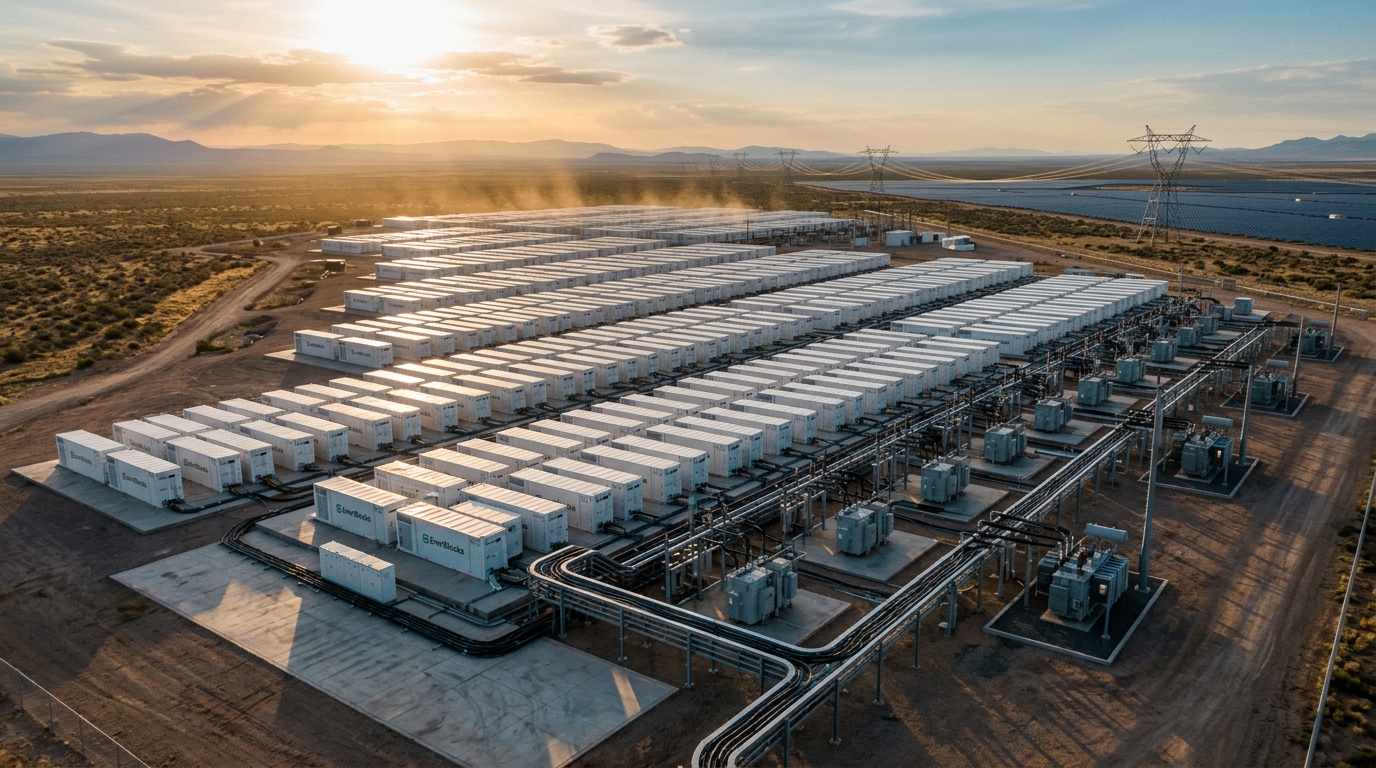
Each EnerBlock is a 42-ton modular unit holding over 30 MWh of capacity. Linking 34 of them creates a 1 gigawatt-hour station — the scale needed to cover California’s evening demand peak, the period after solar generation drops and before overnight baseload stabilizes. The architecture allows operators to configure storage duration from 1 hour to 8 hours by adjusting the ratio of Energy Blocks to Power Blocks. The 8-hour configuration is, by CATL’s analysis, the critical threshold for grid stabilization in high-renewable markets.
The safety profile of the 2027 Power system is a direct consequence of sodium’s thermal chemistry. Thermal runaway in sodium cells peaks at approximately 200°C, compared to 500°C for LFP lithium. The event releases half the heat and one-third less gas. This is not merely a safety improvement — it is an engineering enabler. Because the thermal management requirements are lower, CATL reduced the cooling system’s parasitic power draw from the industry standard of 2% down to 1%, and is actively exploring configurations that eliminate chillers entirely. In a grid battery that cycles 1.4 times per day for 30 years, a 1% reduction in parasitic load represents a material improvement in lifetime economics.
The 30-Year Claim
The most scrutinized element of the 2027 Power announcement is the 30-year lifespan projection. The battery storage industry has a documented history of underperforming on longevity claims — early utility-scale lithium installations routinely degraded faster than projected, and the financial models built on those projections proved optimistic. The 2027 Power claim therefore demands rigorous examination rather than acceptance at face value.
The mathematics underlying the claim are straightforward. A grid battery in continuous operation cycles approximately 1.4 times per day. 2027 Power cells are rated for 15,000 cycles. Dividing 15,000 by 1.4 and then by 365 yields approximately 29 years — the source of the ‘30-year’ headline figure. This is double the cycle life of the best commercially deployed LFP lithium systems. The question is whether the 15,000-cycle rating is credible.
NFPP Cathode: The Material Foundation
The cathode uses NFPP — Sodium Iron Phosphate Pyrophosphate — built from iron and phosphate, two of the most abundant elements in the Earth’s crust. Unlike lithium cathodes, which require cobalt, nickel, or manganese mined from geographically concentrated deposits, NFPP can be sourced from nearly any industrial economy. The anode uses hard carbon baked from cheap biomass — peanut shells, rice husks, coconut shells. The supply chain is, by design, immune to the geopolitical concentration risks that have repeatedly disrupted lithium supply.
High-Entropy Doping: The Engineering Solution
The fundamental failure mechanism in battery cathodes is crystal lattice cracking under the physical stress of repeated ion insertion and extraction. Over thousands of cycles, this microcracking propagates, increasing internal resistance and reducing capacity. CATL’s solution — High-Entropy Doping — seeds the NFPP lattice with half a dozen foreign atoms, creating a deliberately disordered atomic structure. This engineered chaos distributes mechanical stress across the lattice rather than concentrating it at grain boundaries, resulting in a reported 70% reduction in structural fatigue over the rated cycle life.
“We have thousands of test samples. We have field data from installations running since 2021. We have accelerated stress testing and outward failure modeling. This is not a marketing projection — it is an engineering specification.”— Amanda Xu, CTO of Energy Storage, CATL
The Cost Curve
The most counterintuitive fact about the 2027 Power announcement is that sodium cells currently cost more than lithium cells. At $70–97 per kWh versus $42–69 per kWh for LFP, sodium is not yet economically competitive on a raw cell cost basis. CATL declined to announce the system price at the Intersolar presentation, and this is the reason. Understanding why this pricing paradox does not undermine the sodium thesis requires understanding how technology cost curves work.
Every technology has a launch price and a cost floor. The launch price is high because production volumes are low, manufacturing processes are unoptimized, and supply chains are immature. The cost floor is the theoretical minimum determined by the physics and chemistry of the raw materials. Lithium-ion has benefited from four decades of scaling — costs dropped approximately 19% with every doubling of cumulative production. That learning curve has now largely run its course. LFP lithium is approaching its physical cost floor, constrained by the cost of lithium carbonate, the energy intensity of cathode synthesis, and the geographic concentration of raw material supply.
Sodium’s cost floor is structurally lower. Soda ash — the primary sodium precursor — trades at roughly $150 per ton, compared to $15,000–$80,000 per ton for battery-grade lithium carbonate at various points in the recent cycle. Iron and phosphate are commodity chemicals. Hard carbon from biomass is derived from agricultural waste. The raw material cost advantage of sodium over lithium is not marginal — it is approximately one order of magnitude. As sodium production scales and the manufacturing learning curve runs, the cost crossover with lithium is not a forecast; it is a physical inevitability.
Infrastructure Reclassification
The economic implications of a 30-year battery lifespan extend well beyond the technical specifications. They represent a fundamental reclassification of what grid-scale energy storage is — and therefore who can own it and how it is financed.
A lithium battery that degrades meaningfully within 10–12 years is a depreciating asset. It is financed like equipment: short-duration debt, venture capital, or project finance with aggressive amortization schedules. The financing cost reflects the asset’s limited useful life. A sodium battery with a credible 30-year lifespan is classified as infrastructure — in the same category as a natural gas pipeline, a water treatment plant, or an electrical substation. Infrastructure assets are financed at dramatically lower cost of capital, with access to pension funds, sovereign wealth funds, and infrastructure-focused institutional investors whose combined assets under management dwarf the venture and project finance markets.
“The difference between a 12-year battery and a 30-year battery is not a factor of 2.5 in value. It is the difference between equipment and infrastructure — and infrastructure commands a fundamentally different class of capital.”
Deployment Timeline — Key Milestones
- April 2025: 2027 Power unveiled at Intersolar Europe — first public disclosure of specifications.
- 2021–2025: Field data collection period — real-world performance baseline established.
- September 2026: GWh-scale deliveries begin in China — first commercial-scale deployment.
- June 2027: Global shipments commence — international market entry.
- 2028–2030: Cost crossover with LFP (projected) — sodium becomes economically dominant for grid.
- 2030–2035: Sodium approaches cost floor (~$18/kWh) — structural displacement of lithium in grid applications.
The deployment timeline reflects CATL’s characteristic approach: announce specifications with precision, begin commercial delivery at scale, and let the technology’s performance record build the market. Gigawatt-scale deliveries in China beginning September 2026 will generate the first large-scale real-world performance data for the 2027 Power system. Global shipments commencing June 2027 will bring that data — and the technology — to markets in Europe, the Middle East, Southeast Asia, and the Americas.
Lithium is not dead. For weight-sensitive applications — electric vehicles, consumer electronics, aviation — lithium’s energy density advantage remains decisive and is unlikely to be challenged by sodium in the foreseeable future. But for the grid, where weight is irrelevant and the premium is on cost, safety, longevity, and climate resilience, sodium is the future. The 2027 Power platform is the first commercially viable expression of that future. The transition has begun.

- Be the first to comment.

